
Market breadth was weak with 1,260 advances and 1,597 losers on the BSE.

Asset managers are betting big on ETFs these days.

'This looks like a long-term bear market and there could be mounting losses in the near-term,' says Devangshu Datta.

Stellar rally in ITC shares along with strength in the Asian equities capped the downside.

The primary issue market has hit an all-time high with 63 corporates raising Rs 1,18,704 crore through main-board initial public offerings (IPOs) so far in 2021, which is nearly 4.5 times more than the Rs 26,613 crore raised through 15 issues in 2020 and almost double of the previous best of Rs 68,827 crore in 2017, according to a report. Pranav Haldea, managing director of Prime Database Group, said the IPO frenzy was driven by new-age loss-making technology start-ups along with strong retail participation, and the resultant massive listing gains were the key highlights of the year. Another highlight was only 51 per cent or Rs 103,621 crore of the total Rs 202,009 crore was fresh capital raising and the remaining Rs 98,388 crore were offers for sale.

In the Sensex pack, ICICI Bank emerged as the top gainer by rising 0.97 per cent, while Tata Steel advanced 0.92 per cent.

'India's edtech and start-up story will be in danger.'

IndiGo had debt of Rs 3,912 crore at end of the June quarter.
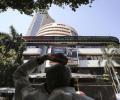
The BSE Sensex was down 326 points at 23,277 and the Nifty was down 107 points at 7,056.

The BSE Sensex zoomed 318 points to end at 33,351.57, while the broader Nifty spurted 88 points to 10,242.65.

IT majors along with metal names Sesa Goa and Hindalco buck trend.

The BSE Sensex gained 104.63 points to end at 33,147.13, while the broader Nifty spurted 48.45 points to finish at 10,343.80.
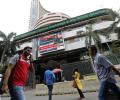
Banking stocks felt the heat due to worries that the lending rate cuts will hit their bottom line
The expected interest rate hike in the US and the resultant volatility in the domestic secondary market could play a dampener to the over Rs 2-trillion initial public offering (IPO) pipeline in 2022. IPOs in 2022 look promising, with as many as 35 companies holding the Securities and Exchange Board of India's approval to raise roughly Rs 50,000 crore. Another 33 companies are waiting for the regulator's nod to raise around Rs 60,000 crore next year.

Small- and mid-cap stocks continued facing selling pressure due to stretched valuations.

Financials declined amid profit taking while energy shares fell after the government hiked excise duty on transport fuels.
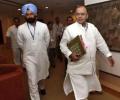
To provide similar extended time limit for payment of tax deducted from payments made to non-residents, it is proposed that the deductor shall be allowed to claim deduction for payments made to non-residents in the previous year of payment.

But experts say downside limited, pockets of opportunities for investors
The Sensex ended at a fresh record closing high of 28,889 while Nifty ended at a fresh record closing high of 8,730.

Construction major L&T was the biggest gainer among the Sensex components, spurting 2.30 per cent, after the company said its board has approved a Rs 9,000-crore share buyback plan.

The Nifty rose 176.50 points, or 1.74 per cent, during the week.

For the seven months since February 2014, the benchmark index surged nearly 27%.

The broader NSE Nifty gained 22 points to 10,480.60
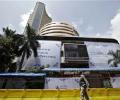
Sensex lost 76 points to end at 25,589 while Nifty shed 23 points to end at 7,649.

The 30-share Sensex ended 271 points higher to end at 28,930 and the 50-share Nifty climbed 76 points to close at 8,776.

This is first time in 25 years that a benchmark equity index in India is trading at a P/E multiple of 40x or higher.

Short-covering and the propping up of net asset values have potential to boost frontline as well as second-rung names next week

The Sensex has now lost 878.32 points in six sessions -- its longest string of losses in six months.

India's equity markets are on a roller-coaster ride, after delivering spectacular returns for two consecutive years - in 2020 and 2021. The benchmark National Stock Exchange's (NSE's) Nifty50 is down 1.5 per cent in the first nine months of the current calendar year 2022 (CY22) as foreign portfolio investors sold Indian stocks due to rising bond yields in the US and across global markets, including India. The sell-off in the Indian equity markets has, however, not been broad-based and largely limited to sectors facing earnings headwinds from rising interest rates, lower commodity and energy prices, and likely economic recession in advanced economies.
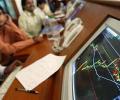
Market breadth ended weak on the BSE with 1,838 declines against 1,218 advances.

The Nifty and Bank Nifty ended at record closing high of 7,913 and 15,865 respectively.
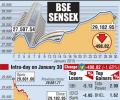
Nifty snaps 10-day winning streak

Key relaxations traced in final regulations.

Sensex falls at close; metals, banks perform well.

Database to contain taxable financial transactions and history of any tax-paying individual.

The broader NSE Nifty too reclaimed the key 11,500-mark. It touched a high of 11,562.25, before finally settling at 11,536.90, showing a gain of 59.95 points, or 0.52 per cent.

The Indian rupee also trimmed most of its early gains and was trading at Rs 61.28 compared to its Wednesday's close of Rs 61.31 to the US dollar.

Global funds have pumped in over Rs 38,000 crore (about $5.5 billion) into domestic equities since February 20, helping the Sensex rebound 2,671 points, or 7.6 per cent, from its 2019 low.

The US dollar index, which measures the greenback's strength against a trade-weighted basket of six major currencies, was up by 0.31 per cent at 97.52.
Among Sensex constituents, HCL Tech suffered the most by diving 2.26 per cent, followed by HDFC shedding 2.10 per cent.
